
I recently spent some time in a local comprehensive school to help out prior to them breaking up for summer. A major part of that effort was helping them untangle practical endorsements and CPACs for A-level Physics. Their feedback to me was very positive so I realised that the advice was probably relevant to a broader audience.
In this post, I look at what the CPACs are, what the role of the school or college is, and how to pass a visit from an assessor. All examples are for A-level Physics with the AQA exam board, which is not the board I teach, but, hey, the criteria are common!
Why do practical work?
Practical work is an essential part of any A-level science programme. It supports and consolidates scientific concepts, it helps the pupils develop investigative skills, and it allows them to build and master practical skills. If this list is insufficient, universities want to know that the exam boards are delivering them fresh blood with at least some experimental nous, so you had better get it right.
With the above in mind, the exam boards got together and agreed a set of common practical assessment criteria (CPACs). Not only do the exam boards all have the same CPACs, but the different sciences also share the same CPACs too. They are a high-level list of expectations of an A-level science graduate in the practical domain.
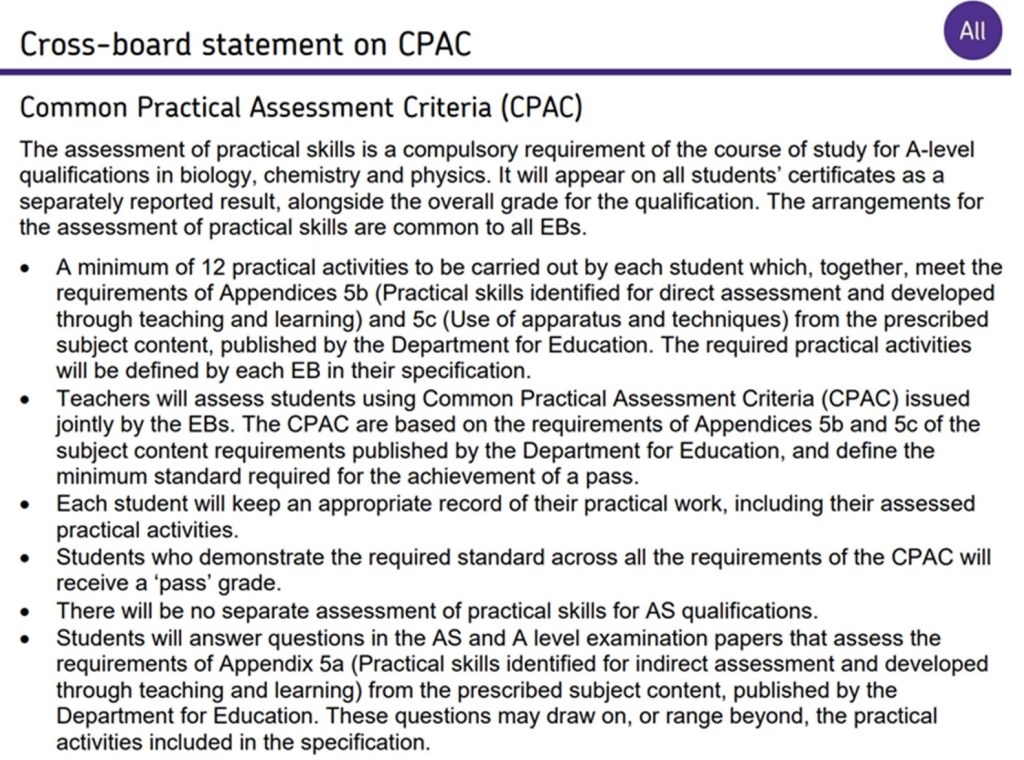
Here is the common statement published by the exam boards:
What are the practical activities?
The exam boards seem to differ quite a bit in what they are asking for. For example, AQA require 12 specific (“required”) experiments to be carried out by the pupils with the option of adding teacher-designed ones as extras. On the other hand, OCR provides 12 “themes” of practicals and then suggests three experiments under each theme to choose from (or do teacher-designed ones as well/instead). At least the number twelve seems to be common!
Here are the required practicals for AQA:

Whilst there are perhaps no surprises in the list – the practicals all seem to be fairly standard expectations for A-level Physics pupils – that is not the point! The point of A-level practical assessment is to test investigative and experimental skills. This means that the choice of practicals is less relevant than the metrics you choose to measure the pupils against for each one. The reason that these are required practicals for AQA is actually because the exam board says it is fair game to ask questions of these specific experiments in the final written exams, so it is important that the pupils understand them in some detail.
As well as the required practicals, teachers can also devise their own challenging practicals too. Here is the overall flowchart showing how pupils can reach endorsement for AQA:

The CPACs
In the flow chart given above, the five competencies are the CPACs. One of our main jobs as teacher is to ensure that the pupils have sufficient opportunity to demonstrate competence as defined by these CPACs and that we are assessing them fairly and robustly. To help us out, the CPACs can be expanded with subsections, although I note that not all exam boards require this:
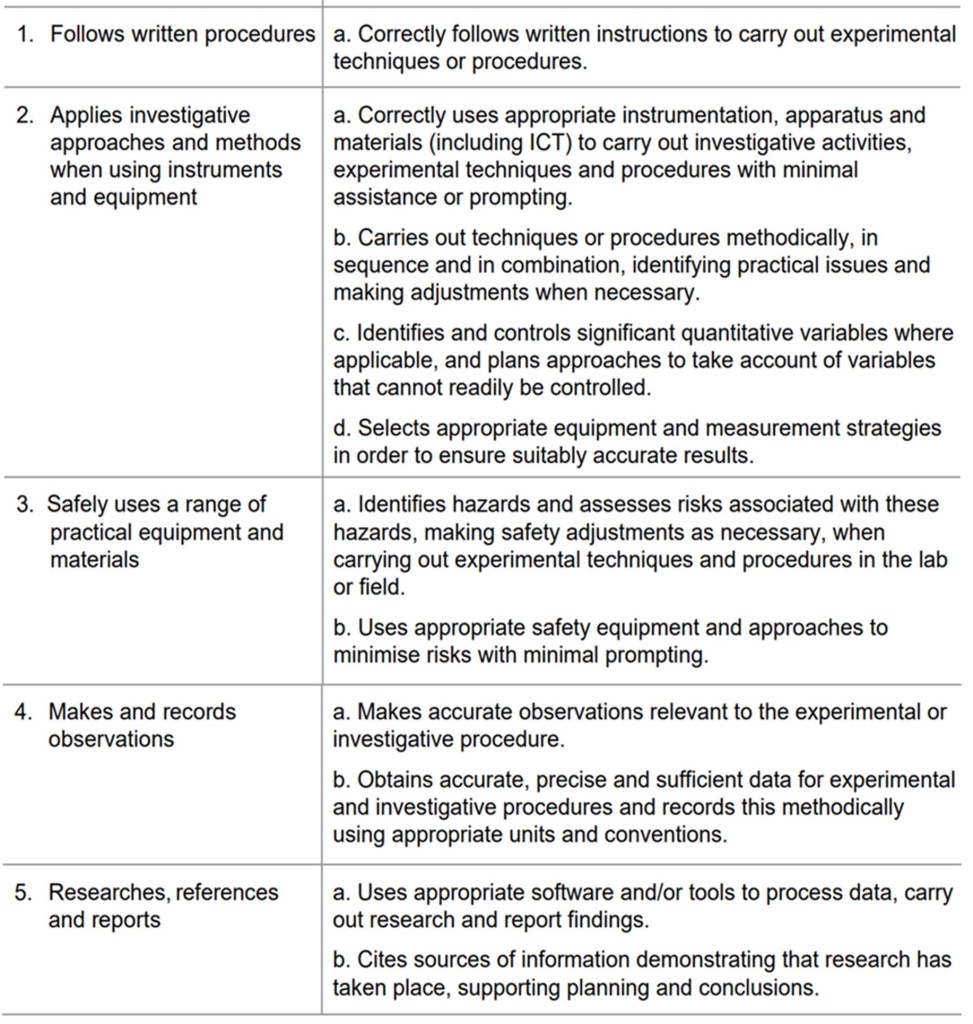
In a future post I will discuss common issues with each CPAC and how to overcome them. For now, let us focus on the process of practical endorsement.
Practical endorsement
A-level pupils will be awarded a separate grade for their practical assessment (either pass or fail). Given the importance of this, exam boards are hot on ensuring schools and colleges are doing it right. You will be visited on a regular basis by someone from the exam board whose job it is to ensure that you: (i) Are compliant with the rules and (ii) are assessing pupils at the correct standard. Whilst this sounds a bit scary, my approach is that a legitimate effort to teach practical skills is okay but turning the practical endorsement into a box-ticking exercise is not okay. If as a school or college you are unable to pass practical endorsements, you are not able to offer the A-level, so it is essential that you get these visits right.
In terms of compliance, there are a set of expectations that you must meet:
- Documented plans to carry out sufficient practical activities which meet the requirements of the CPACs
- A record of each practical activity undertaken and the date when this was completed
- A record of the criteria being assessed in that practical activity
- A record of pupil attendance
- A record of which pupil met the criteria and which did not
- Consistent and routine
- Improvement in standards over time
- Pupil work showing evidence required for the particular task with date
- Any associated materials provided for the practical activity, e.g., written instructions given
- Standardisation within a centre (within a single class; across classes)
We are responsible for ensuring compliance with the above. Whilst the list may seem unwieldy, the wonderful thing is that every exam board under the sun produces a “tracker” spreadsheet which, if you choose to use it (you are not compelled to do so), you will satisfy most of the rules automatically. Using a tracker correctly should tick expectations 1-5 – I strongly recommend you to use one – I like the OCR tracker best for its simplicity. You can navigate to the main trackers here: AQA, EdExcel, OCR
Let us look at some of the expectations in more detail. For point 1, you need to show that you have a plan to get all of your pupils across the line within the two years of their course. The easiest way to do this is to show (with the tracker, for example) that you have planned to hit each CPAC a sufficient number of times over the two years for the pupils to pass. How many times is “sufficient” (see point 5 “consistent and routine”)? Some exam boards say “once,” others say “more than once” (so, presumably “twice” then).
For point 3, you need to decide before the event which CPACs are being assessed for a particular practical. It may be unsatisfactory to pass Johnny on CPAC 1 this time, because, although he has finally managed to follow some instructions, it was pre-determined that CPAC 1 is not actually being assessed on this practical. Point 8 is closely related. Every pupil within the class should be assessed against the same criteria in a given practical, and, if your school or college has more than one class or more than one teacher, every pupil across classes and teachers should be assessed to the same criteria in a given practical too. It is unfair (read “disastrous”) if a pupil’s chances of passing their practical endorsement depends on which teacher they have. I have a feeling that exam boards are getting stricter on uniformity/standardisation, so watch this space!
The easiest way to pass the rules mentioned so far is for all of the relevant teachers to get together before yr 12 and agree which practicals will be carried out with that cohort, which CPACs will be tested per practical, and which specific points will be tested per CPAC.
The latter of these underpins standardisation and there are many ways to achieve it. Pen and pencil works fine, but I work in a fully digital school so I am fond of a spreadsheet. Here is an example of what such a spreadsheet could look like. It is for the practical measuring the resistivity of constantan. The teachers have pre-determined that CPACs 1-3 will be assessed and, furthermore, they have made practical-specific statements that their pupils will be measured against. When the teacher writes a “y” or “n” against one of the statements for a pupil, that box turns green for pass or red for fail. The result is that every pupil is being assessed (by every teacher in every class) to the same standard and the teacher gets an instant visual readout of the pupils’ progress.

Point 6 hints strongly at the pupils maintaining lab books. Whilst there is no requirement for lab books to be maintained per se, I struggle to see how to pass point 6 without one, so lab books are ubiquitous. If you ask your pupils to stick the handouts for the practicals into their lab books, then point 7 is met too.
Summary
In summary:
- Practicals are an essential part of A-level Physics
- The exam boards have collectively agreed criteria against which teachers assess their pupils
- Pupils must pass the practical side of their course as well as the theoretical/examined side
- Our job as teacher is to ensure we are compliant with the rules and that we are assessing to the right standards
- Exam boards audit schools and colleges to ensure compliance with the rules and that the practical work is of the right standard
With this, I wish you every success in getting your cohorts through the practical side of their course. We are in it together.
 Physics Thinking