It is always useful to have one-off lesson plans up one's sleeve for those odd lessons near to holidays. This lesson is on data digitisation, teaching how to convert numerical data and text messages into binary.
A one-off lesson on data digitisation

Thoughts about Physics and teaching Physics
It is always useful to have one-off lesson plans up one's sleeve for those odd lessons near to holidays. This lesson is on data digitisation, teaching how to convert numerical data and text messages into binary.

Space is my favourite topic in Physics. Not only because all pupils will, in their lives, have looked up at the night's sky and started to wonder, but because Space ties several topics of Physics together into one beautiful, unified whole.

I believe retrieval practice is one of the most important aspects of my lessons. The pupils enter the room in silence to find nine interleaved retrieval questions on a grid. They then sit in silence to tackle the questions before we, as a class, go through the answers using cold calling.

Silly questions help spark detailed Physics debate. They are incredibly powerful ways to get your pupils to think outside the box, to increase their knowledge, and to build connections and bridges in their understanding.

I designed these three lesson observation forms for peer observations. One is focussed on teaching, one is on curriculum, and one is on behaviour. The aim is for them to be easier and more useful than generic "catch-all" forms that many schools adopt.
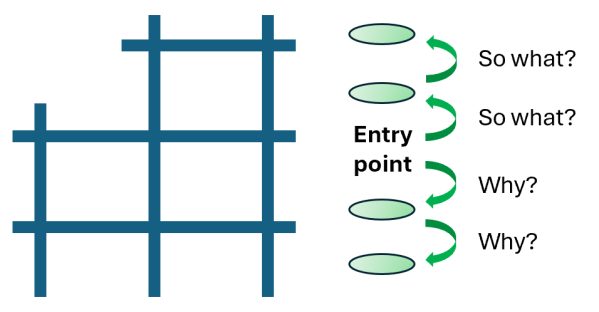
Physics is about questioning the Universe around us. A universal way to scaffold is to ask "why" and "so what." Such simple questions can take a pupil from their entry point in a description to a detailed account of the underlying Physics. A great tool!

Threshold concepts completely transform one's perception of a subject. In Physics, a key threshold concept is that what we measure on the macroscale is because of what is happening on the microscale.

The A-Level topic of electricity usually involves jumping between the microscale and macroscale, which takes huge cognitive load. Here I propose developing schemes of work based directly on the two length scales. The idea comes from threshold concepts.

When do we first realise that we are all budding physicists? Is it as a toddler, when we fall over and gravity inevitably pulls us down rather than up? Possibly.

Artificial intelligence (AI) is here to stay, so we should try to take advantage of it for the completion of certain tasks. Here I demonstrate the creation of a lesson plan and associated worksheets using Chat GPT
There is no ideal way to choose who to give intervention to. Here I discuss the traditional method for weaker pupils versus my method for underperforming pupils.
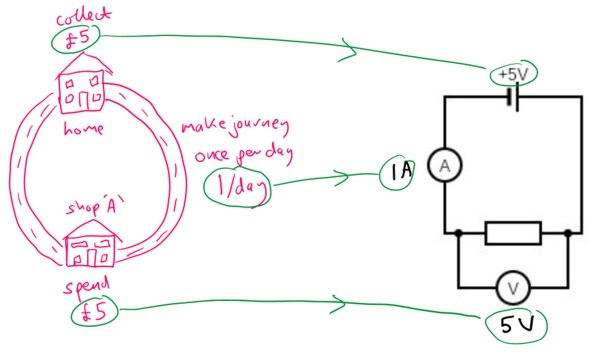
Pupils struggle with learning Electricity because it is too conceptual. Using analogous circuit models helps them understand the basics. My favourite analogous circuit model is the shopping model, which I explain here.

Here are common issues and how to overcome them with CPACs in A-level Physics practicals
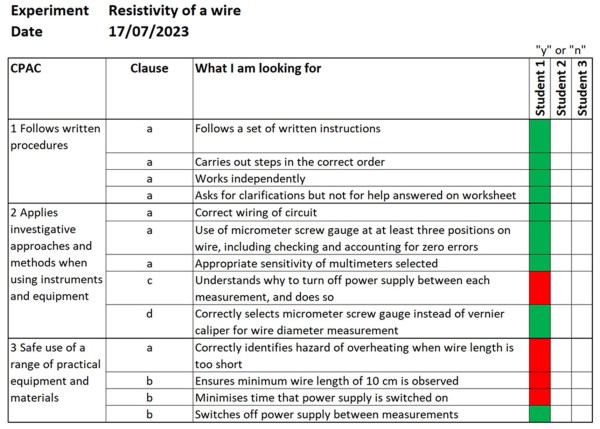
In my first post I discuss CPACs for A-level Physics. How do we as teachers ensure compliance with the rules.
 Physics Thinking