
I recently completed my National Professional Qualification in Leading Teaching (NPQ-LT) and I strongly recommend it to everyone. During the course, the participants were given the task of taking on a change project in our own schools. Upon reflection, I think the main aim was to learn the Education Endowment Foundation’s (EEF) change management model, which, as such models go, seems to be as good as any. The project needed to last about a year, there was no requirement for it to be successful or even to be developed beyond initial planning, but we needed to engage with the change management model in a way that we thought would be meaningful in our own contexts.
I routinely carry out learning and research projects in my school because: (i) It keeps my mind active and (ii) I am a true believer in continuous improvement. Rather than simply attaching one of my ongoing projects to the NPQ-LT, I decided to start a bespoke project just for the purpose of the course. My topic was making lesson observation forms fit for purpose.
Here is the EEF’s change management framework, which I refer to throughout the remainder of the post:
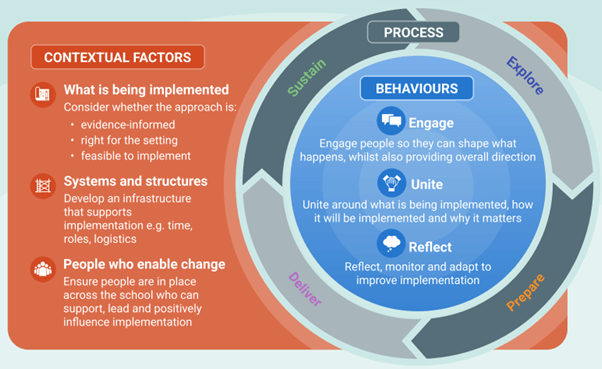
Contextual factors
My idea was to create lesson observation forms that are fit for the purpose of observation. There are many reasons to observe teachers, ranging from formal observations for probation or ECT continuation through to peer observations to learn from or feedback to colleagues. The main issue I have seen in all of the schools I have been associated with is that they only have one lesson observation form, regardless of the purpose of observation. With this in mind, the form tends to be a catch-all form designed to cover everything. This makes it incredibly clunky for specific use and, from my experience, this means that staff tend to ignore the form, write their observations on a scrap of paper, and then shoe-horn their observations into the form regardless of whether or not they are putting their comments in the right section. A few months later and the comments lack all meaning because it is unclear what they refer to. The existing forms maybe suitable for formal, top-down observations, but they do not fit the task of peer observations. From this, my project was based specifically on peer observations.
When we look to the research evidence, the EEF states in their project summary on Teacher Observation that lesson observations have zero months impact on learning! This is very surprising bearing in mind the ubiquity of lesson observations in schools. However, reading the summary in more detail, they go on to say “the lack of impact seen in this study may be because [their] structured Teacher Observation intervention was no more effective than existing practice rather than because general peer observation has no impact.” From this, I was in two minds to continue with the project. On the one hand, my school has a strong expectation of lesson observations but poor compliance, so the project fits within my context and there is a need. However, on the other hand, the research evidence finds no impact at face value. I decided (admittedly with bias) to continue with the project on the grounds that the EEF’s research could be interpreted in such a way that lesson observations do have impact, but the EEF’s method of observation is only as good as everyone else’s.
The project fits my context well. My school has a strong track record of adopting new ideas and testing new initiatives, we are always looking to find positive change, and, by policy, each staff member is expected to observe at least five others per year (which means, as a school, we carry out approximately 700 observations per year).
With the above in mind, I identified the key stakeholders to get onboard within my organisational staff chart, told them what I wanted to do, and got sign off.
Process
Exploration
Here is the EEF’s guidance on the “exploration” phase of the Process:
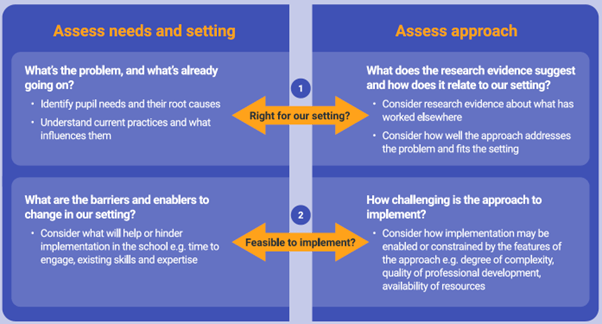
As stated above, although the EEF’s research on lesson observations is questionable, my school has a strong track record of carrying out lesson observations and of trying new ideas. Furthermore, there was agreement amongst the staff that the existing lesson observation form is not fit for purpose. Specifically, it contains too many questions and it is unfocussed. However, when I asked my colleagues directly, it became clear that the staff cohort could not agree on the purpose of lesson observation.
Despite the above, my conversations with colleagues did find some consensus. Firstly, we believe that peer observation nurtures a culture where pupils expect “strangers” in the classroom, which helps prepare for inspections and governor drop-ins. Secondly, we believe that top-down observations help train new staff and ECTs. Thirdly, we believe that peer observations help share best practice. This gave me a baseline to work from whilst keeping my colleagues onboard.
Prepare
Here is the EEF’s guidance on the “prepare” phase of the Process:
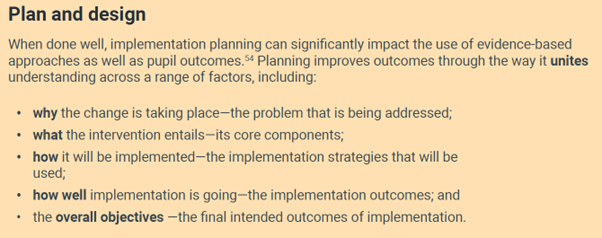
The primary aim of my implementation project is to make peer observation useful to the staff members involved (both for the observer and the teacher being observed). I envisage a secondary result will be improved compliance of the staff to meet the target of five observations per year.
In terms of what I was going to do specifically, I started by thinking about why would I (as a teacher) want to observe another teacher? I considered the option of having one purpose of observation per Teacher Standard, but I soon realised that this would be impractical and not particularly useful. For example, how could I ever possibly judge within a lesson whether or not a teacher is fulfilling his/her wider professional responsibilities? So too, how could I necessarily know whether or not a teacher has made accurate and productive use of assessment? Furthermore, different observation forms for each of the eight Standards, plus presumably one for Part 2, would remove my aim of making observations easy for the staff involved. Instead, I threw this idea out and discussed with a trusted mentor our own motivations for observing others, ab initio. We decided that there were three main reasons for one teacher to observe another:
- Behaviour management, e.g., how does the teacher command obedience, etc
- Teaching style, e.g., teacher voice and positioning within the classroom, etc
- Broader curriculum, e.g., links to previous or future content, links to other subjects, inclusion of EDI, etc
It turns out through my research that my colleague and I are not the only ones who think these are the key purposes of observation. Indeed, Ofsted, in its report “How valid and reliable is the use of lesson observation in supporting judgements on the quality of education,” identifies the three domains of behaviour, teaching, and curriculum as key.
Once these three domains had been chosen, it was fairly straightforward to build observation forms for each purpose of observation, with the underlying aim of being “light touch.” Here are the final forms:
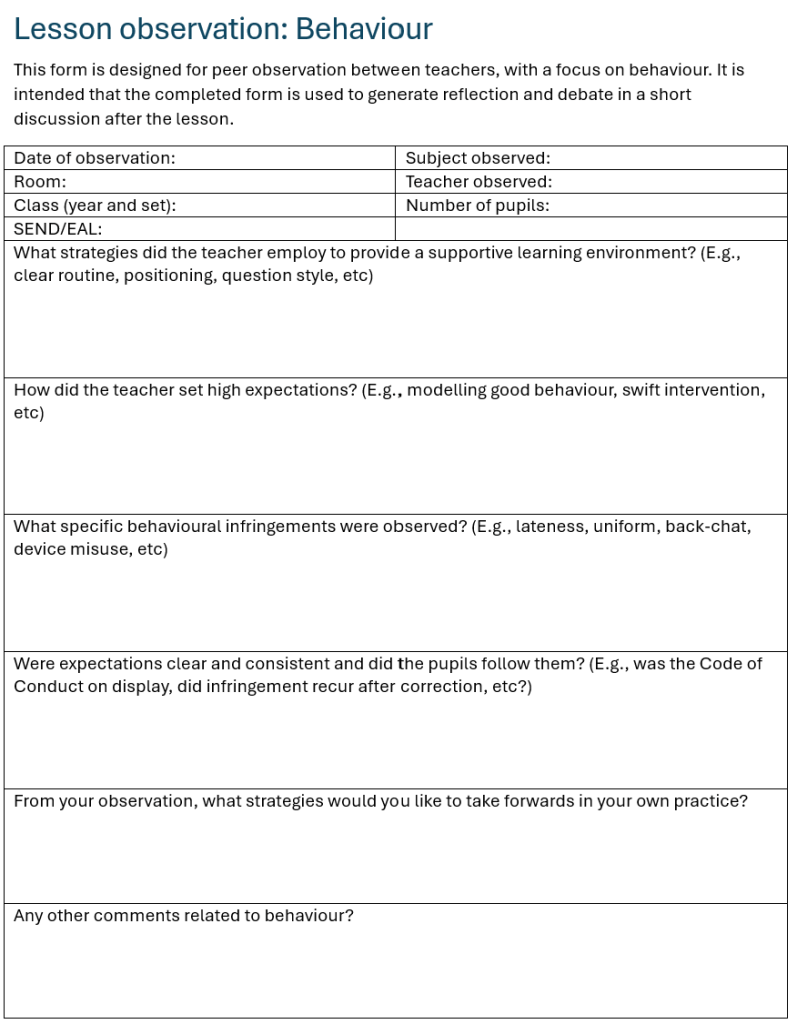
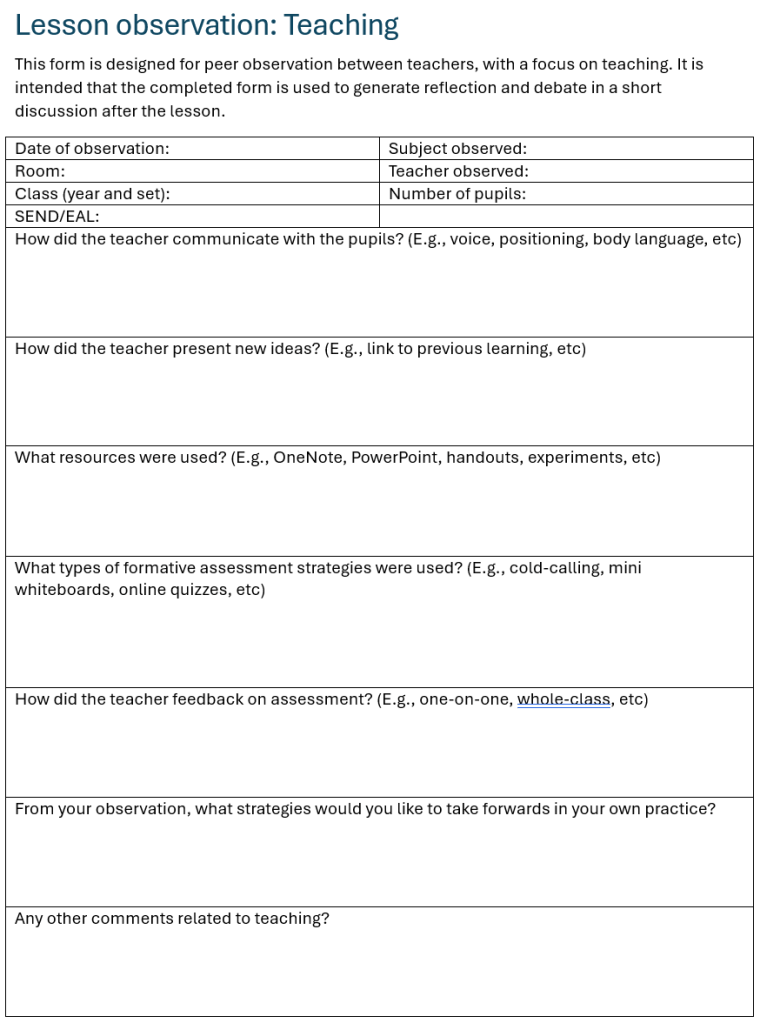
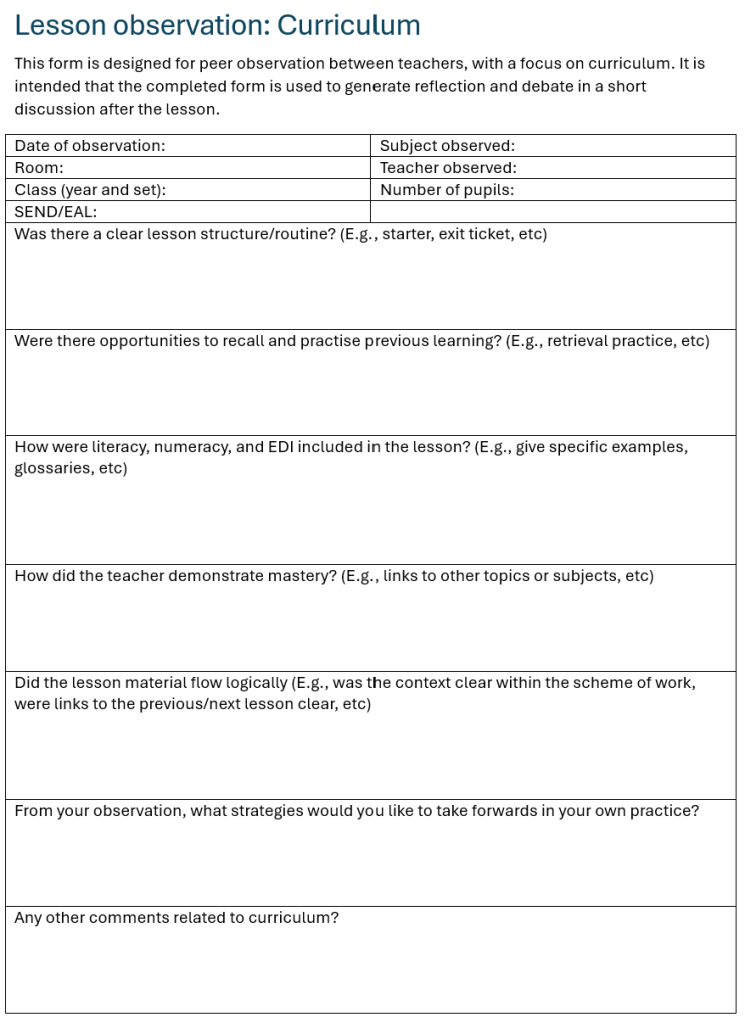
The forms are available as Word documents here:
Hopefully you can see that the forms are fairly light-touch, they are designed to look for the positives, and they should generate debate through feedback. I think the forms should be used within the following structured framework:
- Prior to the observed lesson, agree the purpose of observation with the teacher being observed
- During the observed lesson, complete the lesson observation form
- After the observed lesson, spend 15 minutes discussing your observations with the teacher who was observed, using the completed lesson observation form as a basis for the discussion
Deliver and Sustain
The new lesson observation forms have been rolled out to a small number of staff to test them, but the current feedback is 100% positive. The overwhelming response from staff is that the forms are easy to use, which was one of my main aims with the project. In the upcoming term, the idea is to roll the forms out to my faculty as a whole before implementing them school-wide in the term after.
Conclusions
I have developed three different peer observation forms dependent on the purpose of observation. Initial results from staff suggest that these forms are easy to use (much easier than the catch-all form that is otherwise available). Embedding the forms within a feedback cycle with the teacher being observed helps share best practice between the two teachers.
These forms have begun to be rolled out and this shall continue in a structured way over the coming terms.
Feel free to use the lesson observation forms in your own contexts. I hope you find them as useful as I do.


wow!! 57A one-off lesson on data digitisation
LikeLike