
I believe retrieval practice is one of the most important aspects of my lessons. The pupils enter the room in silence to find nine interleaved retrieval questions on a grid. They then sit in silence to tackle the questions before we, as a class, go through the answers using cold calling. The pupils then self-grade and correct their answers in a different colour pen, with the aim being that they end the activity with nine correct answers and a written history of where they made mistakes, which helps revision later.
This ritual takes place in every one of my classes in each year group that I teach. It primes pupils to engage their Physics brains, it maintains good behaviour by delivering expectation and routine, and it gives my pupils a hot start to their lessons through a bout of formative assessment. It’s pedagogical overload.
Here is a typical retrieval practice grid of mine (year 11):
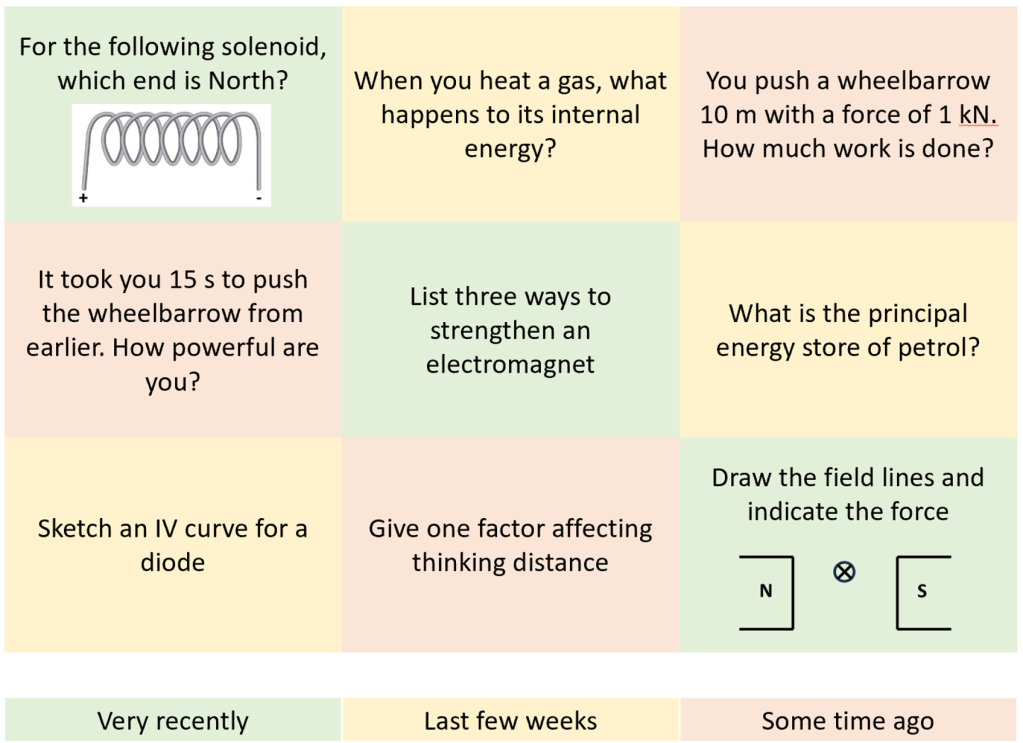
Let’s break down the mechanics of my method.
Interleaving
Interleaving refers to jumping between different topics from one question to the next. You can see from my standard grid that I jump between at least three topics, and sometimes more, usually asking three questions on each:
- Very recently – I am testing key points from the topic of the last one or two lessons to help bring these ideas front and centre in my pupils’ minds so that they get a good start to the current lesson
- Last few weeks – These questions usually come from the last six weeks or so and I purposefully try to include questions from the previous topic
- Some time ago – Anything goes! In year 11, I may be asking questions from as far back as year 7
The main reason for me choosing to interleave my retrieval practice activities is to enhance my pupils’ abilities to decipher information and discriminate between concepts. I am teaching them to efficiently seek out keywords, check this alongside their internal registers, retrieve solution paths, and practice solving problems. A key point of retrieval practice is that the problems should be fairly simple, otherwise too much cognitive load is used up and my pupils do not have much more to give for the rest of the lesson.
A second reason for interleaving is to build resilience and prepare my pupils for their exams. Exams jump between topics from one question to the next, expecting the pupils to be able to follow suit. If the exams are interleaved, then surely one of my roles in preparing my pupils for the exams is to expose them to interleaving. Practising this over five years for GCSE, or seven years for A-Level, should embed it!
Spacing
Spacing refers to study or practice after a period of time. It is quite likely that most interleaved activities are necessarily also spaced, given how schemes of work are designed and lessons are planned, but spacing is a pedagogical tool in its own right.
My main reason for spacing my retrieval practice activities is to try to overcome Ebinghaus’ forgetting. We know that regularly returning to older material helps prevent forgetting and boosts encoding, understanding, and retrieval, so it is important to fit in practice as much as possible. By including spaced retrieval practice as a permanent fixture in my lesson planning, I am embracing an incredibly powerful pedagogical fact.
As a complete aside, and unrelated to this post, I also use spacing with my homework assignments, albeit in a different way. I usually distribute homework two days after the lesson it refers to. This is to give my pupils time to forget what we learnt in the lesson, so they have to work harder on the homework. Spacing can be used both ways: To overcome forgetting in the long run and to make pupils work harder in the short term because they have had chance to forget!
Cold calling
Cold calling – picking pupils at random to answer questions – ensures each pupil makes a reasonable attempt at the questions, in case they are the one required to answer in front of their peers. I am not going choose the pupils with their hands in the air. I am not going to choose the most able pupil to ensure a correct answer and jog the lesson on. I am going to ask anyone, and I will scaffold them to a solution on the whiteboard if they get it wrong.
A side benefit to cold calling in my retrieval practice activities is that it is also my go-to questioning method for the rest of the lesson, so it models and reinforces my expectations.
Timing
I do not set strict time limits on my retrieval practice activities, I measure how long my pupils take, but there is no reason why a strict time limit would not work.
My school sets the Sciences. A top set will probably answer all nine questions within three or four minutes, and we will go through the answers within another three or four, so the entire activity will take six to eight minutes in total. A bottom set will probably answer most (seven or eight) questions within eight or nine minutes, and we will go through the answers within another five or so, so the entire activity will take about quarter of an hour. During this teacher downtime, I am taking the register and then going walkabout around the room, checking in with some pupils and looking over shoulders of others to inspect answers on the fly, keeping a mental record of who I intend to cold call.
Does the activity take too long? I do not think so. Firstly, our lessons are 75 minutes long, so it is not too large a block. Secondly, I think the positive benefits of retrieval practice are so important that I cannot put an upper time limit of acceptability on the activity. In fact, once, as a micro-research project, I wanted to see just how far I could push the retrieval practice activity, adding higher level follow-up questions here, inverting problems there, doing unit analysis elsewhere. I managed to spend the entire lesson just on the retrieval activity and we got through about sixty questions in all (I distributed mini whiteboards on this occasion). The pupils loved the lesson because of its fluidity, stretch, and challenge, and I was able to form a really meaningful picture of where their understanding was in the course.
Pupil response
I have convinced myself time and again that retrieval practice is an essential part of teaching and I cannot imagine ever calling it to a halt. However, what do my pupils think?
In every (really, every) “feedback to teacher” session that I have led, pupils in the upper sets say with complete agreement that retrieval practice is their favourite part of my lessons and they never want it to stop. So, there is strong evidence in favour of using a particular pedagogical tool and there is complete buy-in from the pupils in these more able classes. Who would have thought!
However, pupils in the lower sets tend to say that their least favourite part of my lessons is the retrieval practice activity. In fact, on one occasion, I faced near mutiny as the class had organised themselves prior to the lesson and even nominated a spokesperson to inform me of the fact. It fell on quasi-deaf ears. As I told that class, I am not going to agree to a change that I am certain will have a negative effect on their outcomes. Retrieval practice stays!
With hindsight, and from speaking with a couple of pupils in that class one-on-one, my understanding is that the real reason for negativity was due to the pupils having to do some very hard work from the get-go. The level of my questions was stretching them too far. These pupils are in bottom set because of their relative cognitive abilities as compared to the higher sets. They struggled with retrieval practice because they did not have a large cognitive capacity or ability to chunk well. This was when I realised that my retrieval questions should not be so challenging as to wear out my pupils, and, in the end, I reduced the cognitive load of the retrieval questions for the class to help them more readily experience success.
Question choice
I do not use all the same retrieval questions with each class in a year group. This is because retrieval practice forms part of my formative assessment feedback loop, alongside exit tickets. By this, I mean that I use retrieval practice to partially feedback on last lesson’s exit ticket if there were any major mistakes, especially misconceptions. The questions from “very recently” tend to be bespoke to the class, whereas the other questions may be generic for all classes. This approach has allowed me to build up quite a large bank of questions.
In summary, I believe retrieval practice is one of the most important aspects of my lessons. It brings routine, it helps my pupils build connections, and my lessons begin by reinforcing expectation.
 Physics Thinking
Leave a comment